Dare to understand! · جرأت کن بفهمی!

Mind and Cosmos: A Commentary on Thomas Nagel (in Dari)
A free, chapter-by-chapter commentary in Dari on Thomas Nagel’s Mind and Cosmos — why consciousness, reason and value challenge the materialist neo-Darwinian picture of nature.
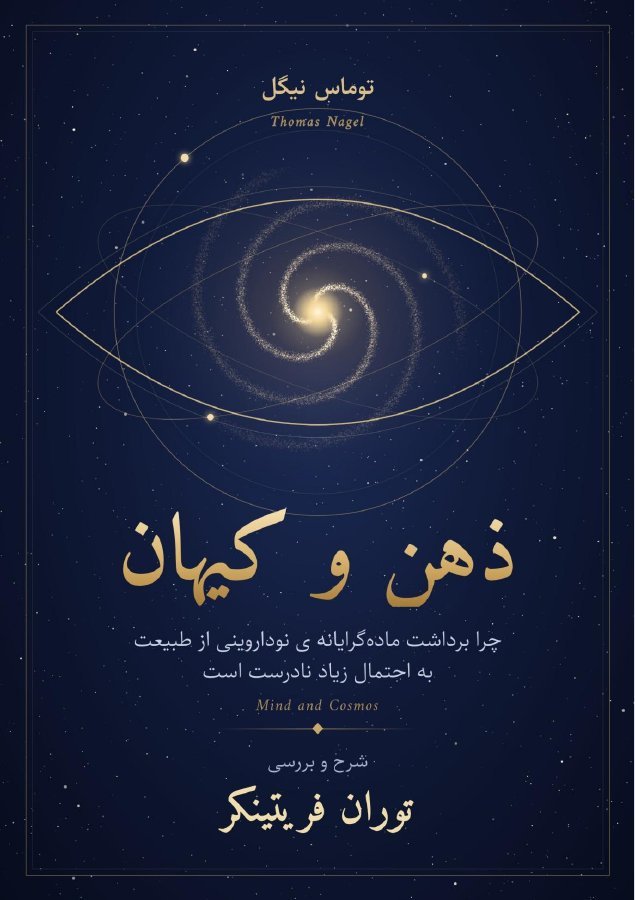
Mind and Cosmos is a short book with a large question. Published in 2012 by Thomas Nagel, the American philosopher best known for his essay “What Is It Like to Be a Bat?”, it asks whether the picture of nature that modern science gives us — a world in which life, consciousness, reason and value are all explained in the end by physics, chemistry and natural selection — can really be complete.
Nagel’s answer is no. He argues that the materialist neo-Darwinian conception of nature is “almost certainly false”: not because he defends religion or intelligent design — he is an atheist and says so repeatedly — but because he thinks a third possibility deserves serious attention: a natural order that contains the seeds of mind and value from the beginning. The book caused a storm when it appeared. Some called it brave; many others saw it as an unfair attack on evolutionary biology.
About the commentary
I have written a chapter-by-chapter commentary on the book in Dari — ذهن و کیهان: شرح و بررسی. It is not a translation. In my own words, I explain what Nagel says in each chapter and what his argument rests on, so that Persian-speaking readers can follow it. I quote a few short sentences from the original in English, with translation, to keep the flavour of Nagel’s voice; at the end of each chapter I add a few lines of my own assessment under the heading “review note”; and key terms and names are explained in footnotes with their English equivalents.
In my closing words I note that the book raises more questions than it answers, and that its critics — among them Brian Leiter, Michael Weisberg and many others — made serious objections. But its value lies in reopening questions that many consider closed. Even those who disagree with Nagel should, after reading it, be able to say more clearly why they think materialism is enough. That, I believe, is what good philosophy should do.
What it covers
- Commentator’s preface
- Chapter 1 — Introduction: the failure of psychophysical reductionism; two questions about probability; intelligent design and fairness; three conditions for a good answer
- Chapter 2 — Antireductionism and the natural order: the intelligibility of the world; theism and materialism as two inadequate poles; rejecting quietism
- Chapter 3 — Consciousness: a history of separation; a chain of failure; from philosophy of mind to biology; six options
- Chapter 4 — Cognition: the problem of probability; the problem of reason itself; Roger White’s argument and a fourth way
- Chapter 5 — Value: realism versus subjectivism; Sharon Street’s Darwinian dilemma; consciousness, agency and will; a history of value and purpose
- Chapter 6 — Conclusion
- Commentator’s closing words
Download
The commentary is free to download, read and share (50 pages, in Dari).
Original book: Thomas Nagel, Mind and Cosmos: Why the Materialist Neo-Darwinian Conception of Nature Is Almost Certainly False (Oxford University Press, 2012).